

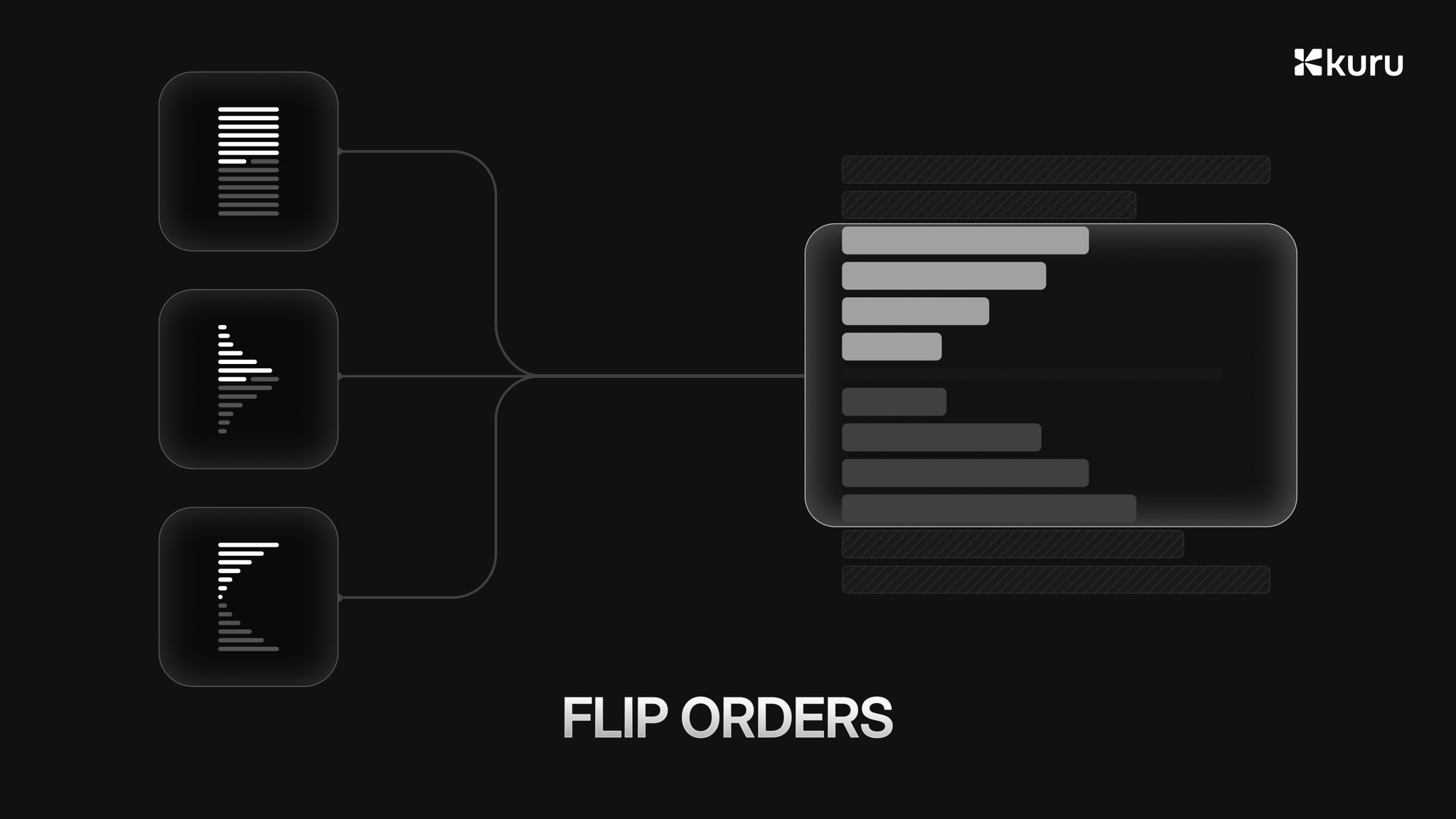
How Flip Orders Work
Let’s say you place a bid at $99 and set a flip price at $101.- When your $99 bid fills, instead of giving you the asset, we instantly place a sell order at $101.
- When the $101 ask fills, we flip it back into the $99 bid.
- This cycle continues every time the order fills, hence the name: flip orders.
Why Flip Orders?
Flip orders make LPing on the order book accessible to everyone without the need for custom infrastructure or active management. They work especially well for pairs like LST/native or stable/stable, where tight price ranges reduce the need for professional market makers. Orders stay live on the book with no need for constant updates— just set your range and let it earn. Liquidity remains on the book with no fragmentation. Read here to learn how to add liquidity to a market on KuruOf Note:
- Flip orders are limit orders and maintain price time priority. Due to this behaviour, just-in-time liquidity cannot frontrun flip order positions
- Since they are orders, large price ranges will mean placing multiple orders and paying gas for every order, making it difficult to place liquidity across large ranges.